
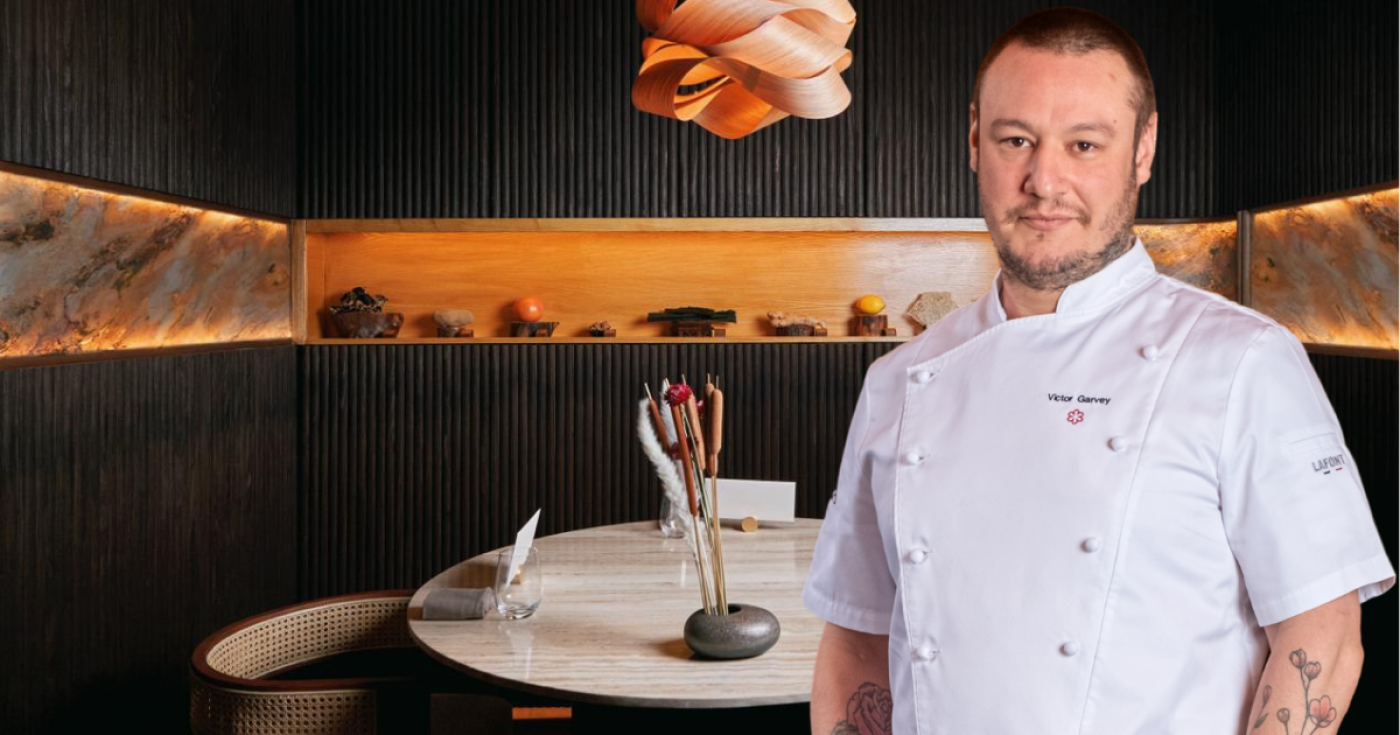
Born in New York and raised in Spain and France, Victor Garvey has been a chef since his mother sent him for work experience to a then little-known restaurant called El Bulli. This month, he is moving his Californian restaurant Sola from Soho, where it opened in 2019, to Westbourne Grove in Notting Hill – next door to his newest restaurant, Mater1a, which he opened four months ago.
Harden’s Insider caught up with Victor at Mater1a to hear how this came about.
Hardens: Victor, it must be a big decision – perhaps even a risk – to move a restaurant like Sola when it is well established.
Victor: Six or seven years ago when I opened Sola, I was very hands-on. Then over time a very good team developed and I didn’t need to be there for every service. But opening Mater1a this year, back working 80 or 90 hours a week, I remembered how much I actually love seeing people’s faces and interacting with them in person.
There’s a reason people with ADHD get into cheffing – the gratification is immediate, not the gratification several months later than a writer or a lawyer may feel. Getting back into that was eye-opening for me. So that is what precipitated the move to close Sola in Soho and move it here.
Will the new Sola be different from the original?
The initial plan was for Sola to be a very ambitious restaurant. But as so often happens, a restaurant takes on its own identity, and Sola became a very good upscale restaurant where people popped in for dinner or lunch. It wasn’t particularly avant-garde or breaking any culinary boundaries, but it was and remains the only American restaurant in Britain or Europe to win a Michelin star – and it was a good business, so we were happy to leave it as it was.
Now though, we have the opportunity to change direction slightly, to make it that bit MORE.
So we are reducing the covers from 24 to 12 and serving one menu only, of 12 courses. With anything over 20 covers, I find it very difficult to manage quality –– that’s the case for me, anyway; I know some chefs are able to manage quality on a much larger scale. And at the same time the wine list is almost tripling in length, with a deep focus on California.
As for the food, we had perhaps got stuck in a pattern of courses – langoustine, quail etc – so I now feel a lot freer to put other items on the menu, expressive ingredients of the type you would find in California. With 12 courses and me being there all the time, we’ll be able to really let our freak flag fly!
Some people will probably say, ‘This is not the Sola we know’ – but we’re booked out for the first month, so the early signs are good.
The name Mater1a specifically references the prime ingredients you source at the restaurant, including much that’s from Japan. So is it a Japanese restaurant?
It’s certainly Japanese-inspired. But the reality is that in 2026 you can’t consider yourself a proper chef unless Japan has to some extent influenced your cooking. To ignore that would be ridiculous – Japanese cuisine has been the most important influence for the last 20 years.
It would be like running an orchestra without wind instruments.
As a chef, it doesn’t matter what cuisine you’re doing, you have to make it taste good – this is the equivalent of the doctor’s Hippocratic oath, to do no harm. But a lot of chefs try to insert stuff from other cultures into their dishes, and it doesn’t work.
Japanese cooking is very ingredient-led, so with ingredients from Japan I will use techniques from my Japan box. I spent a couple of years working there, and go back regularly – last year, I went to beef up my Rolodex of Japanese suppliers who would be willing to send over produce never before exported to the UK for us to use at Mater1a.
This is not a cheap restaurant, and we have extremely expensive and rare produce on the menu: half of it you won’t see anywhere else in the UK, and a quarter of it anywhere in Europe. I’m of the opinion that one of my key jobs as a chef is to procure the best, no matter where it comes from.
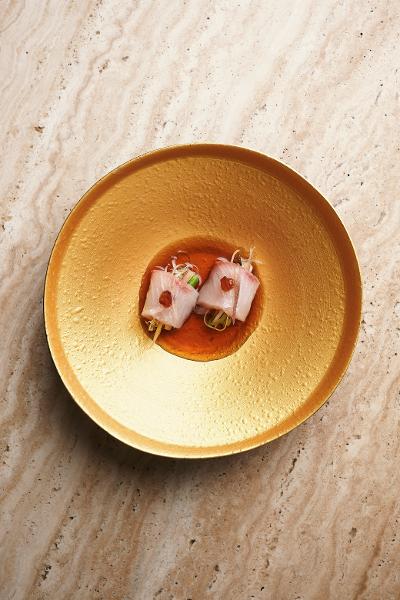
Much of the seafood is in fact from the UK, because there is probably no better in the world. But most of our vegetables come from France or Italy or Japan. We have a van that delivers direct from Rungis market in Paris twice a week, with produce such as morels from the Dordogne or lemons and tomatoes from further south, where they have so much flavour.
On today’s menu we have a fish called amadai – meaning sweet bream or bass – that has scales that crisp when you cook it and very soft flesh. Even in Japan it’s expensive, and we’re paying £110 a kilo to bring it here. People have asked if we could you do something similar with red mullet. Well yes, as a Michelin-starred chef I could – but this is the best fish for this particular dish.
At this price point, people are looking to have their socks blown off. I want people to leave feeling at the very least – oh my God, I’ve never eaten anything like that before! In fact, the most expensive ingredient we have on the menu at the moment is cherries from Yamamoto, which we serve individually to each diner: you’ll never have one like it.
You have clearly identified a market in Notting Hill, which has witnessed a real boom in ambitious restaurants in recent years. Is it one of the areas of London with permanent residents with the means to eat out regularly, as opposed to areas with wealthy owners who spend most of their time abroad?
What I have noticed is that people who live around here are very engaged as residents. They like to go out, and to stay around here to eat.
Another side to having this really engaged guests is the obligation to permanent creativity. We have to switch things up quite a bit so repeat diners don’t eat the same things. So we’ve introduced 10 or 11 new dishes in the four months since we opened.
How do you see the dining scene in London at present?
For a start, I’m happy we have finished with the whole small plates thing. London is very cosmopolitan, and if there is one thing London excels at, it is putting twists on very casual street food. In LA, everybody knows that for the best tacos you go to food trucks, but London is very good at taking casual street food staples and turning them into something special.
Perhaps the best example is Dishoom’s bacon naan – how simple, but how incredible. Would Dishoom have worked in LA or Texas? I don’t know, but I think Londoners have a bit more of an open mind.
Finally, how will you manage the business of being in two restaurants at the same time, of switching cuisines between Mater1a and Sola?
I’ve been pretty well trilingual from birth, speaking English, Spanish and French – when I switch between languages it is like putting on another hat. It’s a similar feeling switching between the two restaurants, compartmentalising.
Everything is very different – not just the flavour profile of the dishes, but also the style of service and the aesthetics. Sola is all white, from the uniforms to the tablecloths to the crockery, whereas Mater1a is darker, with bespoke Japanese stoneware, lacquerwork and carved wood. The two staffs are essentially separate, although there will be some overlap to take account of holidays, illness and so on.
So is there a secret door between the two?
(Victor laughs) Well, I can get from one to the other without walking through the restaurant and out the front door. In Mater1a I wear a dark T-shirt and an apron, whereas Sola is a white-coat place – so I’ll have to do my Clark Kent act!
- Sola opens on Wednesday 17 June at 115a Westbourne Grove, London W2 4UP
