

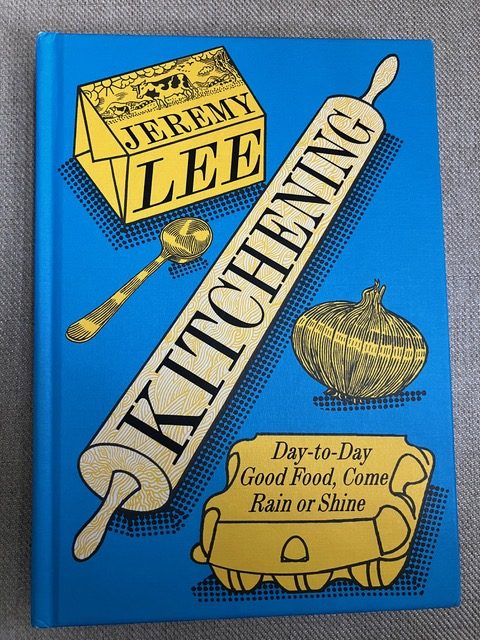
Jeremy Lee, chef-patron of Quo Vadis in Soho, has published a wonderful new book called Kitchening, in which he interweaves 150 of his favourite recipes with anecdotes and reminiscences of his life – mostly in the kitchen. Jeremy kindly agreed to a grilling from Harden’s, responding in his trademark inimitable style.
HARDEN’S: In Kitchening, you describe yourself as a ‘kitchen junkie‘ – someone who spends his holidays away from the professional kitchen ‘whiling away a pleasant time’ in your own or your friends’ home kitchens. Can you tell us what are the differences between professional and home cooking?
Jeremy: Remove the constant of being a job and the kitchen is a haven of quiet, a place where the cook can potter at a gentle pace thinking on while in the throes of preparations – for the now, for later, for the weekend, for the freezer, for the pantry. Making a bacon sandwich, stirring a pot of porridge or custard, making soup or setting to for a great gathering. Often asked if I will get a break from the kitchen when on holiday, I’m tempted to reply that these are the times and the cooking I enjoy mostly. And there are those trimes of perusing books at the kitchen table, jotting down ingredients for a shopping list and then perusing shops and markets, for they are a marvel for stirring the imagination and informing the cook what is best to cook. And lest we forget, there were ne’er truer words spoken than you will always find folk in the kitchen at parties.
A related question: the book talks very much to the ‘home cook’, and you mentioned that you have never worked in a kitchen where the boss is referred to as ‘chef’. Do you think professional cooks/chefs lose something precious if and when they lose contact with home cooking? Or are they two quite separate activities that are best kept apart?
Ah, a complex and vast question this. There was certainly once upon a time a great divide between restaurant cooking and home cooking. Probably mixed up with profession and domesticity being uncomfortable bedfellows and the lot of the housewife bearing no relation to the chef working long days in busy kitchens in a pressured environment. Such times are more and more on the wane as cooks almost now demand that the kitchen be a great learning ground, celebrating great produce, and the vast realm of the food community. Quite simply, a happy kitchen makes joyful food, be it at home or in the workplace.
With your memories of your mother and even grandmother’s skilled home cooking, often referring to recipe books, Kitchening places you firmly as a direct link from the post-War gastronomic world of Elizabeth David, via chefs you worked alongside like Simon Hopkinson and Alastair Little, to what is now called ‘modern British’ cooking (which of course contains many French and Mediterranean influences). Does this feel accurate to you, or is it more complicated?
My goodness, that is quite an honour hearing such. Blush-worthy stuff. I certainly count myself fortunate growing up in a household where good food and cooking were part of daily life, even when we were too young and foolish to appreciate the efforts made by our parents. The house too was crammed with books, newspapers and magazines all boasting food pages, so much so in fact, it seems such were placed in our DNA without our even realising. Not really realising until I stared cooking with folk of like minds and similar tastes for good produce beautifully though seemingly simply prepared, with nods to past, present and of course the future. And lucking out that these kitchens were foremost in the the great movement bringing British food and cooking to the fore, at home and in restaurants. Such wonderful times and seeing so many amazing new talents resulting from these enlightenments is a joy to behold.
You mention Madhur Jaffrey’s books as a key early influence on your cooking. This sounds like an early example of the influence of Asian cooking expanding our gastronomic horizons – now extended as far as China and Japan, and in the other direction to Mexico. Do you foresee other parts of the world that could infuence our cooking in the future?
Gosh, yes of course. Centuries of trade around the world could not help but make their stamp on cooking in the British Isles. For sure the influences of Madhur Jaffrey, Claudia Roden, Anissa Heleu, to name but a few, encouraged the incredible array of cookery writers, cooks and books now being published on all manner of nationalities and their cooking. These influences introduced an elegance and charm not to mention calm to the proceedings, arguably much needed. The British palate is now reflected in the astonishing array of restaurants celebrating cooking from all around the globe and an ever-increasing love of the glories of complex, spiced and flavourful cooking. Is there a style of cooking not yet revealed? Ah – always! It is curious that the next most likely seam of good cooking and produce may well be that of Greece, which has an incredible larder of produce and dishes but has often been overshadowed by the renown of Spain, Italy and France.
And of course, you grew up in Dundee. What has your Scottish (and specifically Dundee) background contributed to your cooking?
Ah, almost, quite definitely ha ha. The Dundee I grew up in was curiously remote and slow to succumb to modern times. The high streets were, albeit a shadow of their former selves, still bustling, and you could still pull up outside the shops in your car and duck into a grocer, a greengrocer, a butcher, a dairy or a fishmonger. There were still a wealth of bakers, and supermarkets were but a glimmer in the eyes of shopkeepers. Mum was an ace cook who always bought food fresh that day and cooked everything for us to scoff with glee. Twas simple fare for the most part, soup, mince and tatties, wonderful lamb and beef, the freshest vegetables, amazing fruit as Scotland enjoys extraordinary micro climates which grow wonderful produce.
Kitchening is organised around months and seasons, and these days every young chef worth their salt proclaims allegiance to seasonality and fresh local ingredients – stuff that serious cooks should always have been familiar with, but have too often ignored. Is there anything else that you think cooks (both home cooks and professionals) are neglecting to pay proper attention to?
Ah, one of the most fascinating results of now having many generations of cooks and restaurants, old and new, is that simple truth that each probably prefer their own cooking, ha ha, and no kid worth their salt wants to cook their parents food even though they may crave certain dishes from times enjoyed, or not, while growing up. Finding a joy in old traditions seems mostly to come with the passing of time and a wistful nostalgia. You have only to look at the produce now available, even with some shocking hikes in prices! Tis amazing to see the bakeries that are now opening with a quality that was almost unthinkable when I started cooking. The same with coffee shops and cheese mongers and fishmongers. There is a joy in the inevitability of cycles, not just of the seasons but of people’s lives and appetites, quite possibly the oldest tradition of them all.
Jeremy, thank you very much for sharing some of the joy with us today.
- Kitchening by Jeremy Lee, with illustrations by John Broadley and photographs by Elena Heatherwick, is published by 4th Estate at £30.
