
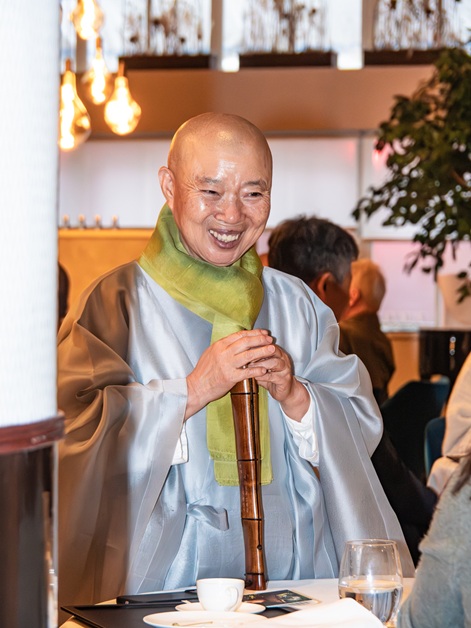
Korean Temple cook The Venerable Jeong Kwan prepared and hosted a special dinner at CORD, Le Cordon Bleu culinary institute’s restaurant near St Paul’s in London, on the last day of October. She spoke to Harden’s before the meal
Now in her late sixties, the Venerable Jeong Kwan has spent the best part of half a century as a Buddhist monk. She lives at the Baekyangsa temple, in countryside 170 miles south of Seoul, which has become a site of pilgrimage to some of the world’s most famous chefs – among them Remi Redzepi of Noma in Copenhagen and Eric Ripert of Le Bernardin in New York – who come to sample her temple cuisine. Appearances on Netflix: Chef’s Table have brought her wider acclaim.
While Jeong Kwan declares “cooking is my vocation”, this does not set it apart from her spiritual life: as a Buddhist, all is one to her – part of a never-ending quest for perfection and enlightenment.
One of the precepts she lives by – “We live in three time zones simultaneously: the past, the present and the future” – applies equally to her spiritual life and to the reality of her cooking: Korean temple cuisine descends from a tradition more than a thousand years old, and might be described as vegan plus – it excludes onions and garlic as well as meat, fish and dairy. But it has long been ahead of the contemporary game in its devotion to seasonality, foraging and localism (Kwan grows her own vegetables and has a 500-year-old citrus tree on her doorstep), and to the preservation techniques – drying, pickling, fermenting – which provide many of its most vivid flavours. It is also the ultimate ‘no-waste’ cuisine: the cloudy water left over from rinsing rice is used as an ingredient, while vegetable cooking water is consumed as soup.
Like her immaculately presented dishes, there is nothing remotely austere about Jeong Kwan, despite her monk’s shaven head. Tiny but a large presence, she is clad in elegant robes she designed and made herself, and alternates quickly between deadpan seriousness and warm laughter.
Does she, Harden’s asked, ever get angry while cooking? Working kitchens are notoriously intense and stressful places.
Oh yes, she smiles, that happens. “Cooking is a process you can’t reverse, so once you ruin your ingredients you can’t get them back” – and when that happens, anger is a natural reaction.
“If I get angry, I need to put all my sincerity and effort into losing that anger. I always have my beads with me, so I close my eyes and repeat a Buddhist prayer three times, and I try to push the anger out of my body and down beneath my feet.”
She expands on her theme: “I met a chef in Berlin who was often short-tempered in his kitchen, he would throw anything he could get hold of at people, including knives! He asked me: you are a Buddhist monk, do you get angry?”
She talked him through the problem and explained what he needed to do. “Three days later I saw him again, and he said: ‘I did it! I was able to control it. I was able to see inside myself.”
Aside from immediate outbursts of frustration and anger, there is also the issue of the more general pressure that builds over time in any kitchen – or other workplace, for that matter.
“People work in very stressful situations. When they get home afterwards, they carry the grudge or stress with them, they don’t let go and it sits on their shoulders all the time.
“We need to learn to look inside ourselves and learn humility. When we go to bed, we need to think about letting go of all of our energy at the end of the day. Then we can wake up with a new energy. If we hold on to the stressful mindset, it becomes a burden – we need to learn to let go of it.”
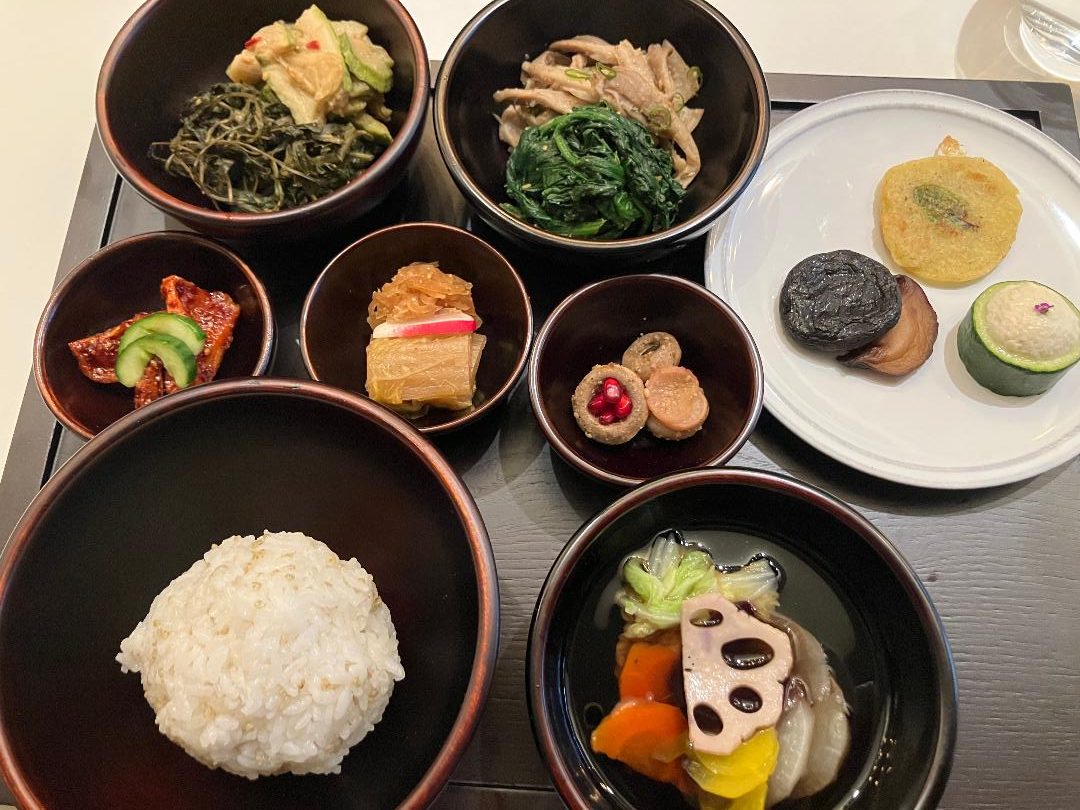
By coincidence, on the very day of Jeong Kwan’s dinner in London, Heston Blumenthal issued a call for Britons to adopt ‘mindful eating’ in response to a health crisis caused at least in part by eating too fast. In support, he released the findings of a survey he had commissioned revealing that many people spend no more than 10 minutes over breakfast and lunch and 20 minutes over dinner, often eating while watching television or otherwise distracted, meaning their senses are not properly engaged on their food.
Heston pointed out that eating quickly has long been linked to various health implications, including weight gain and diabetes, largely because the stomach takes around 20 minutes to send signals to the brain that it is full, so people are more likely to overeat.
Jeong Kwan confirms that this is not just a UK problem. In recent years, she says, Korean eating patterns have changed as small families and solo dining have become more prevalent. “In Korea, it is traditional for us to have a meal together as a family, and children get much of their education from parents at the dinner table – but that is changing.”
In addition, “eating too quickly doesn’t help your body to work well, and when your body gets ill, your mind gets ill. Fast food negatively effects your mind, body and soul, your spiritual temper and your patience levels.”
The answer is to these problems is to look closely at our food culture: at what we eat, how the ingredients come together, how they are cooked, how healthy they are. We need to engage our six senses – “eyes, nose, ears, mouth, heart and movement, each organ of the body and also the spirit” – in a “self-awakening and educating process”.
This process leads to peace and happiness both in ourselves, and in the people around us.
“We need a new era to open up mindful eating and consuming. That is why I am doing my work and communicating what I believe to others.”
Finally, is there one single piece of advice around food that Jeong Kwan can share with us all.
“You need always to be conscious of this very moment,” she says. “So ask yourself: where am I? What am I eating right now?”
